
Whether it’s setting up your altar, reading tarot, or doing spell work the elements are taken into consideration. They are part of the rituals. The elements are taken into consideration with great care and knowledge. Why should making a cocktail be any different? After all, the mixing of ingredients with an intention, even if only to be strong or taste good, can be looked at as spell casting.
We’ve now gone through the contributions and importance of Water and Earth in the alchemy of a cocktail. In this article we’ll be discussing Air. The element of Air relates to knowledge, wisdom, and things unseen but felt. In tarot Air is associated with the suit of Swords. Swords are linked to logic, reason, communication, analysis, and planning.
We already began discussing air a little bit when talking about glassware. The amount of air that is in the glass actually does have an effect on the drink. Aeration in wine is very commonly discussed, but it is also important in cocktails as well. This is one of the reasons some cocktails are stirred instead of shaken. Now you may think that sounds bougie AF, but I promise you …it’s science. We’ll talk further about that in the element of Fire article. Just like the air around you that you breathe, wine and cocktails need to breathe as well and the proper glass can help them do that.
You could get lost in having 60+ different shapes of glasses for various cocktails or varietals of wine and beer. However there are some standards that are good to have in the home that can cover the basics of what kinds of drinks you’ll probably be making. Some good things to have: white and red wine glasses, rocks or double rocks glasses, coupes (rounded edged martini glasses with a stem), some neat glasses or snifters, pints and collins glasses. This may seem like a lot, but again, it all depends on what you generally like to make at home and drink. The intention of what cocktail goes in what glass is more logical when you can visualize the shape.
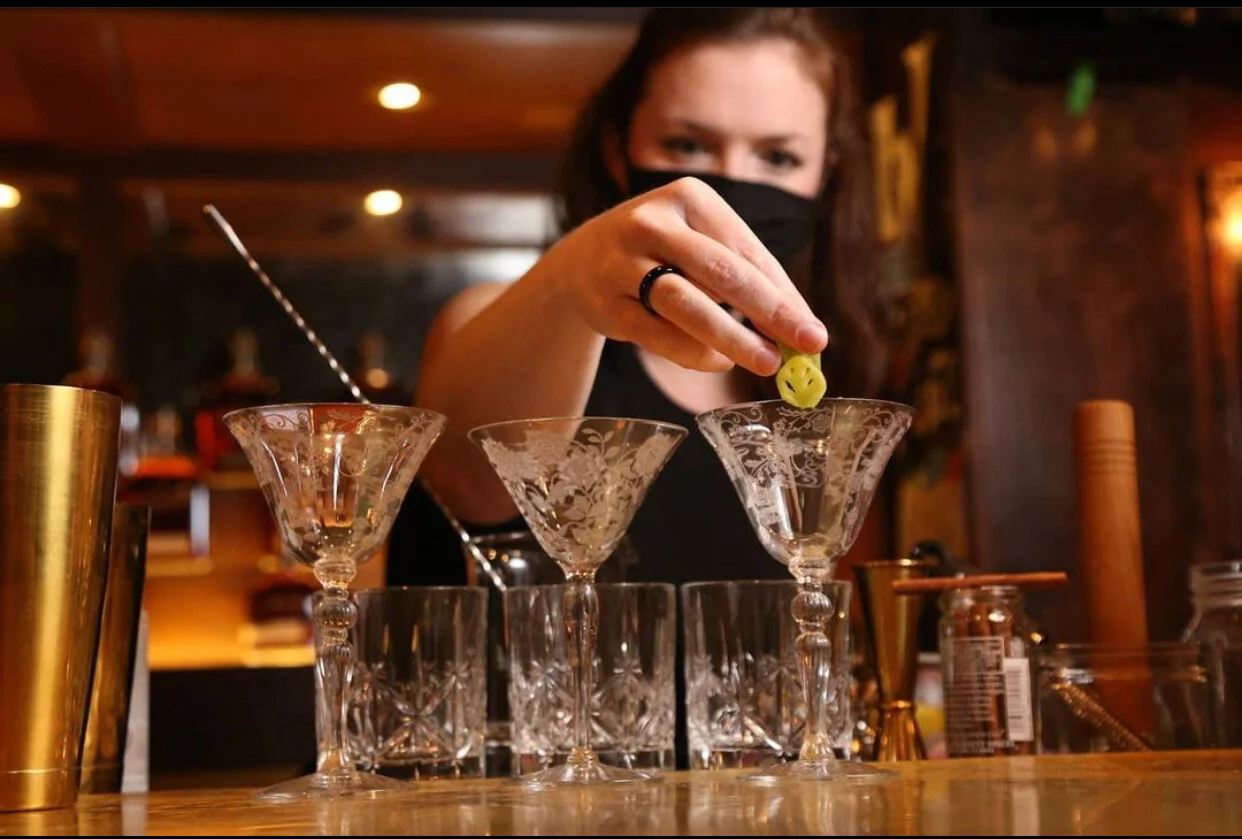
Me applying a garnish to some vintage coupe glasses. You can see some double rocks glasses behind them.
For example, you wouldn’t put an Old Fashioned or Manhattan in a tall pint glass. It would take a much longer time to travel up the side of the glass and take a sip. These are much better suited for rocks glasses. Some of the glassware can be and should be multi purpose. The coupe glass for example is great for martinis, drinking anything chilled and served up, as well as sparkling wines. Having a stem on the coupe means that your body heat transferring from your hand to the glass won’t heat up the liquid in the glass as fast. The pint glass will often warm up faster by your body heat, which is why it is often that things that you drink a little faster go into them. Things like lower alcohol percentage beers, sodas and non-alcoholic cocktails.
Enough about glassware, now back to the element of Air. As Air is associated with things unseen but felt as well as analysis this is a good time to discuss culture in relation to cocktails. Not just the cocktail culture as a whole but the fact that there are some drinks that are connected and rooted in a specific culture that the drink can’t be separated from, nor should it be. For this I’m going to use Puerto Rico as an example. Now I need to say first and foremost that I am not Puerto Rican and do not speak about the culture in any way other than of what I experienced there when I have visited each time.
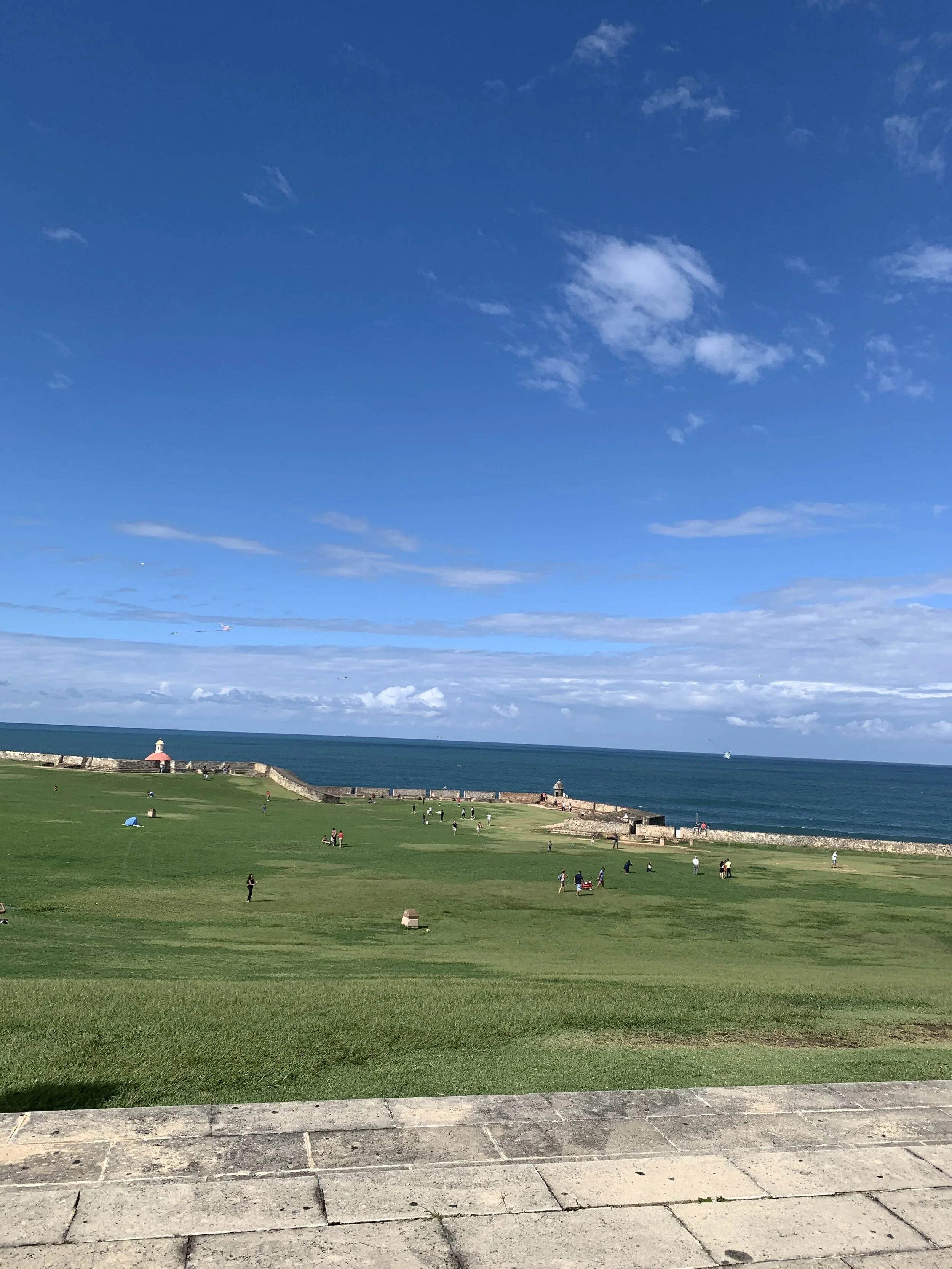
Gorgeous San Juan, Puerto Rico
As we are coming up on the holiday season and Yule, firstly I want to talk about the Coquito, not to be confused with coqui, which is a small from – the size of a penny! – you can hear around the island at night. Coquito is a holiday and New Year’s drink made from coconut milk, sweet condensed milk, egg yolks, spices and of course a good amount of Rum. This is something similar to egg nog. The difference between Coquito and Egg Nog is the tradition and the culture that it inhabits. Recipes are saved and passed down in families. There are similar drinks in Spain and other parts of the world like Cuba where they add coconut ice cream. The knowledge is past and kept and it is in the tradition of this drink where it gets its power and magic. This magic and tradition is kept alive by Puerto Rican people making their family recipe for friends. (Or at least one hopes they are lucky enough to make the list). This kind of tradition and ritual is found in many cultures around the world. The intentional aspect of making a drink specifically for a time of year can be seen as the same kind of intentional magic that we practice of changing out items on our altar.
Another kind of cultural magic happens when you introduce a visitor or otherwise an outsider to something magically and specifically associated with your home. Like that place someone HAS to go if they’ve never before been to where you live, or that drink that needs to be purchased. After all culture and the hospitality industry of food and drink go hand in hand. In keeping with the Puerto Rico traditions, one of such things that I had never experienced anywhere else was Chichaito. Chichaito is a rum and star anise (licorice), drink often taken as a shot. It was offered to us by several local establishments has a thank you for stopping and spending money in their particular bar. It was offered in a sense of community and welcoming. While these sentiments can be true in other places in the world, the drink or accompanying offering would be different. This gesture is in keeping with the element air as a way of communication, telling someone they’re welcome.
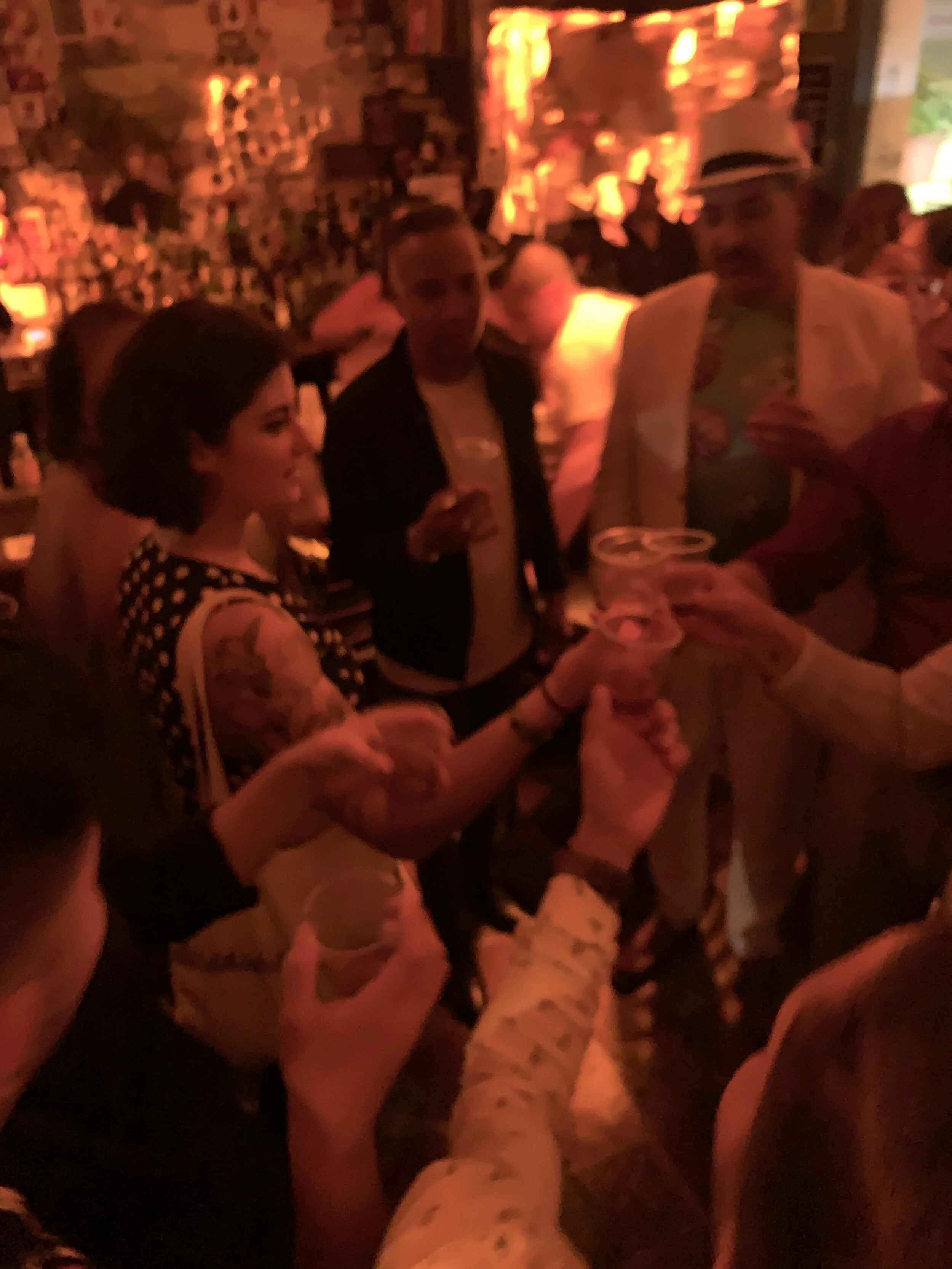
Blurry photo of a group. Salud!
The last thing I’d like to talk about with air is this idea of logic and how that connects to cocktails. There are rules that are rooted in logic and science and then there are “rules” that have arbitrarily been assigned by society. I cannot begin to tell you how many times I’ve heard someone gender a drink. Why? I have no idea. The answer seems to be rooted in toxic masculinity and the patriarchy, but I’m not about to dive into how those ideas are pervasive in the hospitality industry – not in this article, at least. This is an “societal rule” that is not based on logic whatsoever.
What do I mean by a cocktail being gendered? Having a man tell me he didn’t expect his drink to look so “froo-froo” or pink or be served in a glass with a stem are all examples. Other examples include someone refusing a cocktail because it was a specific color, assuming I will make drinks too sweet because I’m a woman, not expecting this woman to straight up school a dude on whiskey knowledge when he makes an off handed comment. Now, I say all of that to say this: know when breaking the rules are accepted and logical.
![- An example of a cocktail I was sent back because, “It’s pink and girly”. [Ed. note: plz send this my way. -Tika]](https://images.squarespace-cdn.com/content/v1/5e055ea85a754606e68c45ee/1608258841555-NPG5ZNZCOVZVJWXK5JNS/IMG-5472.jpg)
An example of a cocktail I was sent back because, “It’s pink and girly”.
[Ed. note: plz send this my way. -Tika]
When is breaking the rules accepted and logical, you ask? When you’re not intentionally or unintentionally offending anyone. When you’re in your own home and you can do whatever you’d like (within reason obviously). When you’ve understood why the rule is set up that way. Example time. When you know that a martini was traditionally a stirred cocktail to ensure proper chill, dilution, leave all of the intricacies of the vermouth flavor in tact and have a smooth mouth feel and you still decide you prefer a more aerated version, then go for it! It’s your cocktail and you deserve to have it the way you want. There’s a fine line to walk with this though.
Do you prefer to drink your sparkling wine out of a wine glass instead of a coupe or flute?
Do you prefer your served-up cocktail in a rocks glass because it feels more comfortable in your hand? Fine.
(If it’s because you think stemmed glassware is too feminine, I would ask that you reassess why you’re gendering glassware).
If that’s something you know about yourself, just tell your bartender while you’re ordering. Where things get a little tricky is when ordering off of a preset cocktail menu and you’re asking the bartender to change the spirit. “Can I have this with Tequila instead of Gin?” While understandable, make sure you are respectful when and if the answer is “No”. You never know who was the original creator of that cocktail menu or that particular drink. They may be the one making it for you. If they know that drastically changing the base spirit takes away from the intention of the cocktail, follow their advice. Be respectful. Respecting fellow humans should feel like logic, but as soon as there is a power dynamic in which one is in a more “service” role and the other is being “served”, logic and mutual respect doesn’t always remain.
The idea of communication and logic in cocktails may have seemed like a stretch when you first started this article, but I hope you’ve found it entertaining and perhaps a little bit informative. If there is any other kind of knowledge you’d like to gain on this topic, please let me know. I’d love to hear from you. Next up and lastly I’ll be discussing the element of Fire and how it plays a part in the alchemy of a cocktail.